Healing From Within: An Ayurvedic Physician’s Perspective on Managing Psoriasis
Understanding Psoriasis Beyond the Surface
In my years of clinical practice, I have sat across from many individuals seeking relief from chronic skin conditions. Among all the dermatological concerns I encounter, psoriasis carries a unique emotional weight. It is a condition that is visible to the world, often leaving individuals feeling vulnerable, isolated, and deeply frustrated. Many walk into my consultation room after having tried a myriad of topical applications, temporary suppressive treatments, and radical lifestyle overhauls, only to find the plaques returning vigorously. Psoriasis was the first case, which I learned as the first case in OPD during my college days. Therefore, I feel an added responsibility to find cure in this condition.
To truly understand psoriasis, we must stop looking at it merely as a skin disease. Skin is the mirror of our internal health. It is our largest organ, an expansive canvas that reflects the state of our metabolic fire, our blood purity, and our emotional equilibrium. In the modern medical paradigm, psoriasis is classified as an autoimmune, inflammatory condition characterized by the rapid overproduction of skin cells. Instead of the normal monthly cycle of cell turnover, a psoriatic skin cell matures in just a few days, leading to the characteristic buildup of thick, silvery scales, redness, and intense itching.
From an authentic Ayurvedic perspective, this rapid proliferation is not an isolated error of the skin itself. It is a systemic cry for help. When we treat psoriasis at our center, we do not focus solely on scrubbing away the plaques or numbing the itch. We look deeper into the underlying environment of the body and mind that allowed this imbalance to take root. By shifting our perspective from fighting the skin to nurturing the internal ecosystem, true and lasting healing becomes possible.
The Ayurvedic Concept of Kushtha and Psoriasis
Decoding the Dosha Imbalance
In the ancient classical texts of Ayurveda, skin disorders are grouped under a broad medical umbrella known as Kushtha. Psoriasis aligns closely with the descriptions of Ekakushtha and Kitibha Kushtha. Rather than viewing diseases as rigid labels, Ayurveda analyzes them through the dynamic lens of the three bio-energies, or doshas: Vata, Pitta, and Kapha. Psoriasis is rarely caused by a single dosha; it is a complex, tridoshic imbalance where all three forces are compromised, though their proportions vary from person to person.
- Vata Dosha: This energy governs movement, dryness, and circulation. When Vata is dominant in psoriasis, we observe extreme dryness, rough texture, severe scaling resembling fish scales, and intense pain or cracks in the skin. Vata causes the skin to flake off so rapidly.
- Pitta Dosha: This force governs metabolism, heat, and transformation. When Pitta is heavily involved, the lesions become bright red, hot to the touch, highly inflamed, and intensely itchy or burning. Pitta-dominant psoriasis is prone to bleeding when scratched and can flare up severely during warm seasons or times of high stress.
- Kapha Dosha: This energy governs structure, fluid balance, and lubrication. A Kapha imbalance manifests as thick, raised plaques, deep-seated oozing, heavy scaling, and a persistent, dull itch that feels deeply embedded in the tissues.
The Role of Dhatus and Toxins
The manifestations on the skin do not stay localized. According to clinical understanding, the vitiated doshas travel deeper into the body's tissues, specifically affecting the Rasa (plasma), Rakta (blood), Mamsa (muscle tissue), and Lasika (lymph). When these four components are simultaneously compromised, the cellular intelligence of the skin is disrupted.
Simultaneously, the accumulation of Ama—metabolic toxins resulting from incomplete digestion—clogs the microscopic channels of nutrition and elimination (Srotas). When these channels are blocked, the skin is deprived of essential nourishment while metabolic waste remains trapped beneath the surface. This dual crisis of nourishment failure and toxin retention is the true birthplace of a psoriatic lesion.
The Modern Lifestyle Connection
The Crisis of Digestion and Incompatible Foods
In our contemporary lives, we are exposed to variables that our ancestors never had to navigate. The primary catalyst for the alarming rise in autoimmune skin conditions is the breakdown of our central metabolic fire, known as Agni. When Agni is weak, even the healthiest food cannot be broken down efficiently, turning into the toxic residue Ama.
One of the most profound observations I have made in my practice is the role of Viruddha Ahara, or incompatible food combinations. In today's global culinary landscape, mixing ingredients that possess opposing bio-properties has become common. Consider these frequent habits:
- Combining milk with sour fruits, berries, or bananas in smoothies.
- Consuming fish or seafood alongside milk-based sauces or cheeses.
- Eating chilled desserts immediately after a hot, heavy meal.
- Consuming highly processed foods loaded with synthetic preservatives and chemical stabilizers.
Over time, these mismatched combinations acts like a slow, low-grade poison within the digestive tract, gradually corrupting the blood chemistry (Rakta Dhatu) and triggering systemic inflammation that eventually erupts onto the skin.
The Mind-Skin Axis: Stress and Emotional Chaos
We cannot talk about psoriasis without addressing the profound connection between the mind and the skin. In Ayurveda, the mind (Manas) and the physical body are inextricably linked. Stress is not merely a psychological state; it is a physical event.
When you experience chronic psychological stress, anxiety, or suppressed grief, Vata dosha becomes highly erratic, and Pitta increases, releasing inflammatory chemicals into the bloodstream. Almost every patient I treat recounts a major emotional upheaval—a loss, a career crisis, or prolonged marital strain—just months before their first major psoriasis flare-up. The skin acts as an emotional safety valve; when the mind cannot process the stress, the skin bears the burden.
Early Signs and Progressive Symptoms
Recognizing the subtle shifts in your body before a full-blown flare-up can make a significant difference in managing the condition effectively. Psoriasis rarely appears overnight without warning. It often begins with minor, seemingly unrelated symptoms that indicate internal toxic buildup and dosha irritability.
Initial Indicators
- Unusual Dryness: Persistent, localized dryness that does not respond to regular moisturizers, particularly on the elbows, knees, or scalp.
- Mild Discoloration: Subtle pinkish or brownish patches that feel slightly raised or rough compared to the surrounding skin.
- Transient Itching: An intermittent itching sensation that worsens during times of fatigue, late nights, or dietary indiscretions.
- Changes in Nail Texture: Tiny pits, ridges, or slight discoloration in the fingernails or toenails, which is often misdiagnosed as a mild fungal infection.
Advanced Manifestations
As the imbalance deepens and involves the deeper tissue layers (Dhatus), the symptoms become more definitive and stubborn:
- Well-Defined Plaques: Raised, red patches covered with a thick layer of silvery, micaceous scales.
- Auspitz's Sign: Pinpoint bleeding that occurs when the surface scales are removed or accidentally scraped off.
- Symmetrical Distribution: Lesions appearing symmetrically on both sides of the body, such as both elbows, both knees, or identical areas of the lower back.
- Fissuring and Bleeding: Deep, painful cracks developing in areas where the skin flexes, such as the palms, soles, and joints, making basic movements agonizing.
Holistic Ayurvedic Treatment Approaches
The Multidimensional Path to Healing
At Sukrutham Ayurveda Chikitsalayam, our approach to treating psoriasis is rooted in clinical truth: there are no shortcuts to healing a deeply ingrained systemic imbalance. True resolution requires a patient, structured, and compassionate approach that works in harmony with the body's natural regenerative cycles.
Our treatment methodology relies on a threefold framework:
[Shodhana] Deep Internal Purification (Panchakarma)
│
▼
[Shamana] Balancing Restorative Herbs
│
▼
[Pathya-Apathya] Strict Dietary & Lifestyle Re-alignment
We begin by stabilizing the aggravated doshas, followed by systematically extracting deeply embedded toxins from the tissues, and finally, rebuilding the skin's natural immunity and barrier function.
The Power of Panchakarma in Psoriasis
When psoriasis has progressed, simple oral medications are rarely enough to break the cycle of chronic inflammation. This is where Panchakarma—the five bio-purificatory therapies of Ayurveda—becomes indispensable. These therapies are not luxury spa treatments; they are intense, medically supervised procedures designed to draw metabolic wastes out of cellular structures and expel them from the body.
1. Snehapana (Therapeutic Oleation)
Before toxins can be eliminated, they must be loosened from the deep tissues. This is achieved through Snehapana, where the patient consumes gradually increasing doses of medicated, herbalized ghee on an empty stomach for three to seven days. The ghee acts as a vehicle, penetrating deep into the cells, neutralizing fat-soluble toxins, and lubricating the dried, Vata-ravaged tissues from within. While it may seem counterintuitive to consume large quantities of fat for a skin condition, this step is vital for calming Vata and softening systemic hardness.
2. Vamana (Therapeutic Emesis)
For individuals exhibiting strong Kapha dominance—characterized by thick, oozing patches and intense, deep-seated itching—Vamana is highly effective. Conducted under careful clinical observation, this induced emesis clears the upper gastrointestinal tract, eliminates excess Kapha, and rapidly reduces the thickness and scaling of the skin.
3. Virechana (Therapeutic Purgation)
The definitive therapy for blood purification and Pitta regulation is Virechana. By inducing controlled purgation using specific herbal formulations, we eliminate excess bile, clear liver congestion, and flush toxins out through the lower intestinal tract. Virechana directly cools the blood (Rakta Shodhana), which is reflected in a noticeable reduction in redness, burning sensations, and active inflammation within days of the procedure.
4. Takradhara (Medicated Buttermilk Pouring)
Given the undeniable impact of stress on psoriasis, Takradhara is an integral part of our treatment protocol. In this therapy, a continuous, rhythmic stream of warm, medicated buttermilk infused with cooling herbs like Amalaki and Musta is poured over the forehead (the ajna chakra). This deeply soothing treatment calms the central nervous system, reduces Vata volatility, improves sleep quality, and interrupts the stress-flare cycle that keeps so many patients trapped.
Botanical Wisdom: Herbs for Skin Restoration
Ayurvedic pharmacology uses a sophisticated understanding of plant energetics to balance the body. For psoriasis, we select herbs that possess bitter (Tikta) and astringent (Kashaya) tastes, as these are inherently cooling, anti-inflammatory, and blood-purifying.
Key Therapeutic Herbs
- Neem (Azadirachta indica): Celebrated for centuries as a premier skin savior, Neem is intensely bitter. It directly purifies the blood, neutralizes excess Pitta and Kapha, destroys systemic toxins, and alleviates itching.
- Guduchi (Tinospora cordifolia): Known as Amrita (the nectar of immortality), Guduchi is an exceptional immunomodulator. It does not blindly stimulate the immune system; rather, it corrects cellular intelligence, calms autoimmune hyper-reactivity, and reduces systemic inflammation.
- Manjistha (Rubia cordifolia): This powerful red root is arguably the most efficient blood cleanser in the Ayurvedic pharmacopoeia. It cools the blood, dissolves stagnant lymphatic fluid, improves localized microcirculation, and helps return psoriatic skin to its natural color.
- Khadir (Acacia catechu): Classical texts identify Khadir as the ultimate herb for all skin conditions (Kushthagna). It dries up excess fluid congestion, strengthens the integrity of the skin layers, and stops the rapid, abnormal cell turnover.
- Turmeric (Curcuma longa): Containing active curcuminoids, Turmeric acts as a natural anti-inflammatory and cellular protector, supporting liver function and enhancing the skin's defensive barrier.
Food as Medicine: The Psoriatic Diet
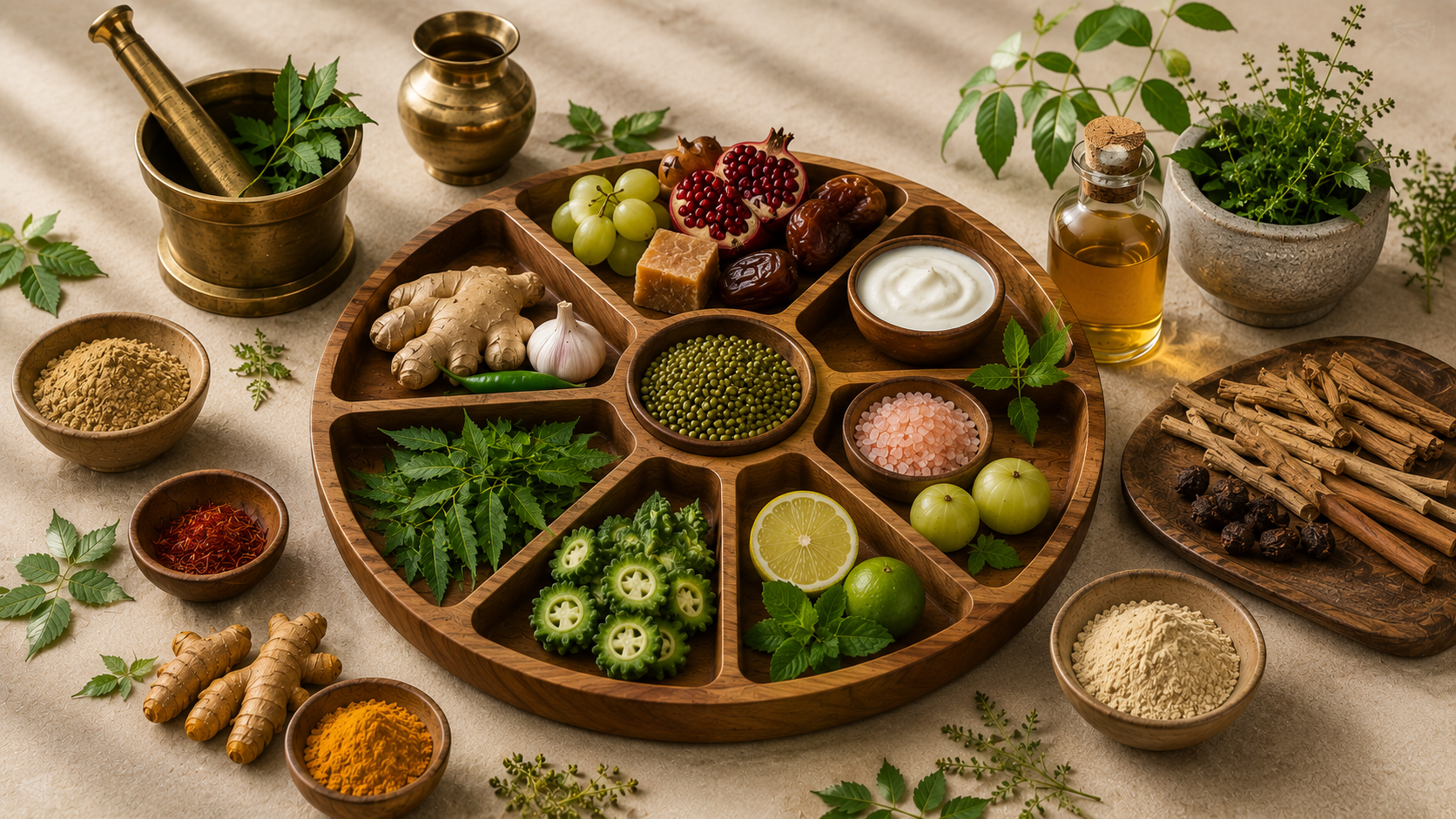
What you put into your body is just as important as the therapies applied to it. A corrective diet for psoriasis focuses on lowering inflammation, supporting digestion (Agni), and preventing the formation of Ama.
What to Embrace (Pathya)
|
Food Category |
Recommended Options |
Therapeutic Benefit |
|
Grains |
Aged rice, barley, quinoa, oats |
Easy to digest, non-clogging to the channels |
|
Vegetables |
Bitter gourd, bottle gourd, ridge gourd, ash gourd, zucchini |
Cools the blood, pacifies Pitta and Kapha |
|
Pulses |
Mung dal (green gram), red lentils |
Provides light, easily absorbable protein |
|
Fats |
Organic cow's ghee (in moderation) |
Lubricates Vata, cools Pitta, supports digestion |
|
Spices |
Turmeric, cumin, coriander, fennel, ginger |
Enhances Agni without overheating the blood |
Export to Sheets
What to Avoid (Apathya)
- Nightshade Vegetables: Tomatoes, eggplants, white potatoes, and bell peppers introduce specific alkaloids that can trigger inflammatory pathways in sensitive individuals.
- Sour and Fermented Foods: Heavy curd (yogurt), aged cheeses, vinegar, pickles, and alcohol overheat the blood and agitate Pitta dosha.
- Refined Sugars and Flours: These place a heavy burden on digestion, promote systemic inflammation, and feed unhealthy gut flora.
- Excessive Salt and Red Meat: High sodium intake and heavy meats increase blood density and amplify the burning and itching sensations of psoriasis.
Daily Preventive Care and Lifestyle Practices
Sustaining clear skin requires a commitment to a lifestyle that minimizes stress and honors the natural rhythms of the body.
Skin Hydration and Protection
- Natural Emollients: Never allow psoriatic skin to become completely dry. Apply pure, organic coconut oil or oils infused with Wrightia tinctoria (Stree Kutaja) immediately after bathing to seal in moisture.
- Gentle Cleansing: Avoid harsh, synthetic soaps containing sulfates and artificial perfumes. Use green gram powder (Mung dal flour) mixed with water or specialized Ayurvedic cleansing bars formulated with neem and oil bases.
- Soft Clothing: Wear loose, breathable cotton clothing. Avoid synthetic fabrics like polyester or tight denim, which trap sweat, create friction, and aggravate plaques.
Harmonizing the Mind-Body Rhythms
- Abhyanga (Self-Massage): When the skin is not actively oozing or highly inflamed, a gentle, daily self-massage with lukewarm, tailored oils calms the nervous system and stabilizes Vata dosha.
- Pranayama (Breathing Practices): Dedicate twenty minutes daily to cooling and calming breathing exercises. Shitali (cooling breath) and Anuloma Viloma (alternate nostril breathing) are particularly beneficial for lowering systemic heat and mental stress.
- Prioritize Restful Sleep: Ensure you are asleep by 10:00 PM. The hours between 10:00 PM and 2:00 AM are governed by Pitta dosha; this is the time when your liver carries out its deep, metabolic detoxification. Staying awake during these hours disrupts this process, keeping toxins in circulation.
Common Mistakes in Managing Psoriasis
In my interactions with patients, I frequently see well-meaning individuals make choices that inadvertently delay their recovery. Awareness of these common pitfalls can help protect your skin from unnecessary flare-ups.
1. Excessive Scratching and Peeling
When itching is intense, scratching provides temporary relief, but it triggers a phenomenon known as the Koebner response. Psoriatic lesions can develop in any area where the skin experiences trauma. Forcing off dry scales or scratching aggressively damages the skin layers, causing the psoriasis to expand into those injured zones.
2. Over-Cleansing and Hot Water Baths
Many believe that scrubbing the skin vigorously or using very hot water will clean away the scales and soothe the irritation. In reality, hot water strips away the skin's remaining natural oils, causing a rebound flash of dryness and triggering a severe itching episode shortly after the bath. Always use lukewarm or cool water.
3. Relying Solely on Surface Treatments
Applying external creams—even natural or Ayurvedic ones—without correcting internal digestion is like painting over a damp, peeling wall. The superficial layers may look clear for a brief window, but until the underlying blood impurities and metabolic toxins are resolved, the condition will surface again at the earliest opportunity.
4. Premature Discontinuation of Treatment
Because skin cell cycles take time to normalize and deep tissue purification is a gradual process, Ayurvedic protocols require consistency. A common error is stopping the herbs or deviating from the diet the moment the skin clears. True Ayurvedic resolution requires continuing treatment for a period after external symptoms vanish, ensuring that the root imbalance is thoroughly stabilized.
Insights from the Consultation Room
Real-Life Observations
Clinical experience teaches us things that textbooks cannot fully capture. Over years of practicing at Sukrutham Ayurveda Chikitsalayam, I have come to realize that no two cases of psoriasis are identical. A protocol that clears the skin of one individual may require adjustments for another, simply because their baseline constitution (Prakriti) and life circumstances differ.
I recall a patient—a young software professional—who came to us with severe scalp and palmar psoriasis. His hands were so deeply cracked that he could barely type or hold an object without pain. He had tried various strong local applications, but the relief was short-lived.
When we evaluated him, we discovered that his work schedule involved constant night shifts, an irregular diet of fast food, and significant performance anxiety. His psoriasis was fundamentally a Vata-Pitta manifestation driven by lifestyle irregularities and mental fatigue.
Instead of prescribing a generic skin remedy, we reshaped his daily routine. We initiated a course of gentle internal oleation (Snehapana) followed by Virechana to clear the blood tissue. Alongside this, he underwent daily Takradhara to address his high stress levels. We worked together to adjust his diet, replacing inflammatory snacks with easily digestible meals and introducing cooling herbs like Guduchi and Manjistha.
The transformation did not happen overnight. It required patience over several weeks. Slowly, the deep fissures on his palms began to heal, the intense scaling subsided, and his natural skin texture returned. What was most rewarding was watching his confidence reappear. He returned to his work not just with clearer skin, but with a deeper understanding of how to listen to and care for his body.
The Necessity of Personalised Care
This case underscores an essential truth: Ayurveda is entirely personalized. There is no single, generic pill for psoriasis. Effective treatment depends on identifying whether your condition is predominantly driven by dry Vata, inflamed Pitta, or congestive Kapha. It requires a careful assessment of your digestive strength, your tissue vitality, and your emotional environment. True healing is a collaborative journey between the physician and the patient, requiring time, mutual trust, and disciplined lifestyle adjustments.
Finding Real Resolution and Long-Term Peace
If you are currently managing psoriasis, I want you to know that you do not have to settle for just hiding your skin or managing constant flare-ups. Your body has an inherent ability to heal itself when provided with the correct internal environment, appropriate guidance, and patient care.
Psoriasis is undoubtedly a challenging companion, but it can also serve as an indicator, calling your attention to aspects of your lifestyle, diet, and emotional well-being that require care and realinement.
At Sukrutham Ayurveda Chikitsalayam, we approach dermatological health with clinical precision, traditional authenticity, and deep empathy. We understand the physical discomfort and emotional strain that comes with chronic skin imbalances. Our goal is to guide you safely through deep internal purification, rebuild your digestive health, and provide you with practical, sustainable tools to preserve clear skin and vitality for years to come. Healing is a gradual process, but with dedicated care, it is entirely within reach.
Frequently Asked Questions
1. How long does it take to see visible results with Ayurvedic treatment for psoriasis?
Because Ayurveda works by purifying the blood and balancing deep-seated tissue layers, results are gradual and vary based on the chronicity and severity of the condition. Generally, minor changes in itching and redness can be observed within 3 to 4 weeks of starting consistent treatment, a proper diet, and lifestyle adjustments. Comprehensive management and long-term stabilization typically require 3 to 6 months, and sometimes longer for deep-seated imbalances.
2. Is it necessary to undergo Panchakarma for psoriasis, or can oral medicines alone cure it?
For mild or very recent cases of psoriasis, oral medicines (Shamana Chikitsa), dietary changes, and stress management can often bring effective relief. However, for chronic, widespread, or frequently recurring psoriasis, Panchakarma is highly recommended. It extracts deeply embedded toxins from the tissues, lowering the chances of future flare-ups in a way that oral medicines alone cannot match.
3. Why does my psoriasis worsen during the winter season?
Winter is naturally characterized by cold, dry weather, which increases Vata dosha in the environment and inside our bodies. This environmental dryness saps moisture from the skin, exacerbating the scaling, dryness, and cracking associated with Vata-dominant psoriasis. During these months, extra attention must be paid to internal and external hydration using suitable Ayurvedic oils.
4. Can I consume dairy products if I have psoriasis?
While fresh, warm cow’s milk or organic ghee can be beneficial for balancing certain types of Vata dryness, dairy must be consumed with caution. Cultured dairy like heavy yogurt (curd), sour buttermilk, cheese, and paneer can congest the metabolic channels and aggravate Pitta, worsening skin inflammation. Most importantly, dairy must never be combined with sour fruits, fish, or salt, as these form highly inflammatory, incompatible combinations (Viruddha Ahara).
5. Can stress alone trigger a psoriasis flare-up even if I am strictly following my diet?
Yes, stress is a major catalyst for psoriasis. The mind-skin connection is profound in Ayurveda. Psychological stress quickly agitates Vata and Pitta doshas, releasing inflammatory chemicals that can disrupt the skin's barrier function and trigger cell overproduction, even if your diet is balanced. Incorporating regular breathing exercises (Pranayama), meditation, and ensuring adequate sleep are vital components of a successful management plan.
Technical SEO Metadata & Supporting Assets
- SEO Title: Understanding Psoriasis: An Ayurvedic Approach to Root-Cause Healing